



Finance Through The Ages
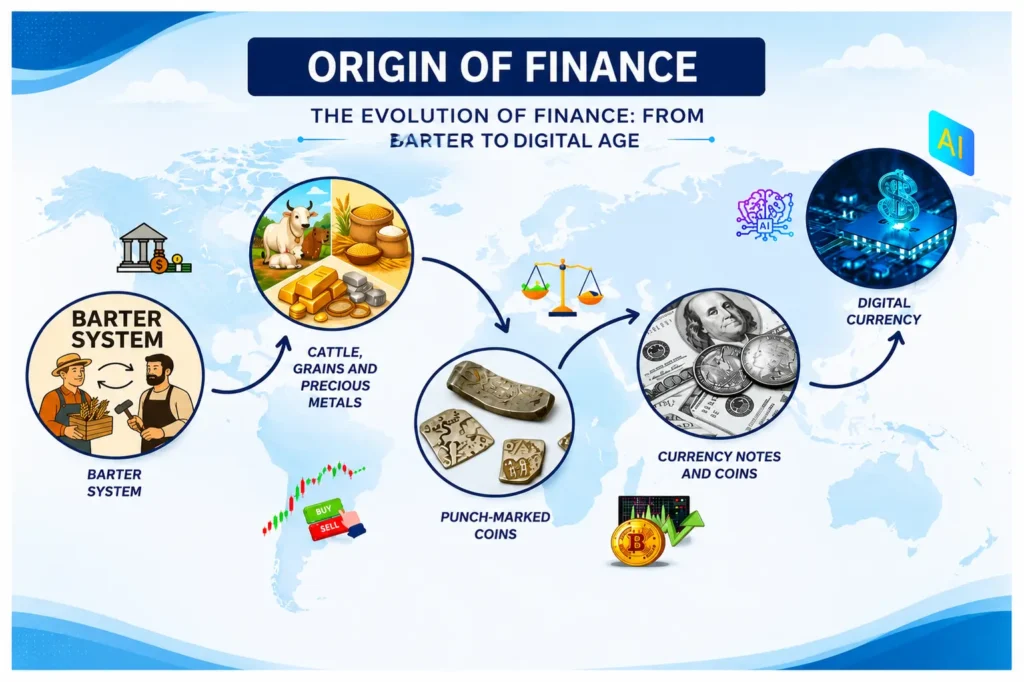
Finance has evolved alongside human civilisation itself, constantly reshaping itself to meet the needs of trade, business, and economic growth. It began with the barter system, where goods were exchanged directly for other goods. But barter had its limits, and money soon emerged as a more reliable medium of exchange. Around 3000 BCE, civilisations in Mesopotamia — the historic region between the Tigris and Euphrates rivers, often called the cradle of civilisation — used grains, cattle, and precious metals like silver and gold to trade and store value. In India, commerce initially relied on cowrie shells around 2000 BCE before evolving into structured currencies such as punch-marked coins, Mauryan coins, and later the Gold Mohur, Silver Rupee, and Copper Dam during the Mughal era.
As trade expanded, so did the need for organised banking. During the medieval and Renaissance periods, merchant banks flourished in Italian city-states like Venice and Florence, with influential families such as the Medici pioneering innovations like double-entry bookkeeping and credit systems. In India, modern banking began with the establishment of the Bank of Hindustan in 1770 — the country’s first banking institution.
Rise of Stock and Capital Markets
The 17th to 19th centuries witnessed the rise of organised capital markets. The Dutch East India Company issued the world’s first publicly traded shares in 1602, followed by the establishment of the London Stock Exchange (1801) and the New York Stock Exchange (1817). In India, the Bombay Stock Exchange (BSE), founded in 1875, laid the foundation for organised share trading and institutional investment — becoming one of Asia’s oldest stock exchanges.
Globalisation of Finance
The 20th century transformed finance into a truly global industry. The Bretton Woods Agreement of 1944 established institutions such as the IMF and the World Bank, creating a more stable international monetary system. In India, the financial sector progressed from moneylenders and colonial banks to a structured ecosystem, driven by banking reforms, economic liberalisation, and institutions like the State Bank of India and the Bombay Stock Exchange — expanding access to credit and capital for millions.
The Digital Finance Era
The 21st century has redefined finance through rapid technological innovation. Electronic trading, fintech, digital payments, blockchain, artificial intelligence, cloud computing, and big data have transformed how financial services are delivered — making the industry more efficient, accessible, and data-driven than ever before.
This remarkable journey — from simple barter transactions to AI-powered financial systems — has created a vast and dynamic industry offering diverse career opportunities across banking, investment management, corporate finance, auditing, risk management, fintech, and consulting. Today, globally recognised qualifications such as ACCA and CFA equip aspiring professionals with the expertise to thrive in this evolving landscape and unlock rewarding career paths across the world.
ACCA: Association of Chartered Certified Accountants
The Association of Chartered Certified Accountants (ACCA) is one of the world’s leading professional accounting bodies, offering a globally recognised qualification for aspiring finance and accounting professionals. Its curriculum builds expertise in accounting, finance, taxation, auditing, business strategy, and management through three progressive levels. While the qualification includes 13 examinations, eligible B.Com and M.Com graduates can claim exemptions for up to five papers, reducing the requirement to 8. Recognised in over 180 countries, ACCA is valued for its practical learning approach, high professional standards, and strong focus on ethics — making it an ideal choice for those building a career on the global stage.
CFA: Chartered Financial Analyst
The Chartered Financial Analyst (CFA) designation, offered by the CFA Institute, is one of the most respected credentials in the global investment industry. Designed for aspiring investment and finance professionals, the programme focuses on investment analysis, portfolio management, corporate finance, financial markets, and ethical decision-making across three progressive levels — CFA Level I, II, and III. To earn the charter, candidates must also hold (or be in the final year of) a bachelor’s degree, or have 4,000 hours of relevant professional work experience along with professional references. Recognised worldwide for its rigorous curriculum and strong emphasis on ethics, the CFA equips professionals with the expertise needed for careers in investment management and financial analysis.
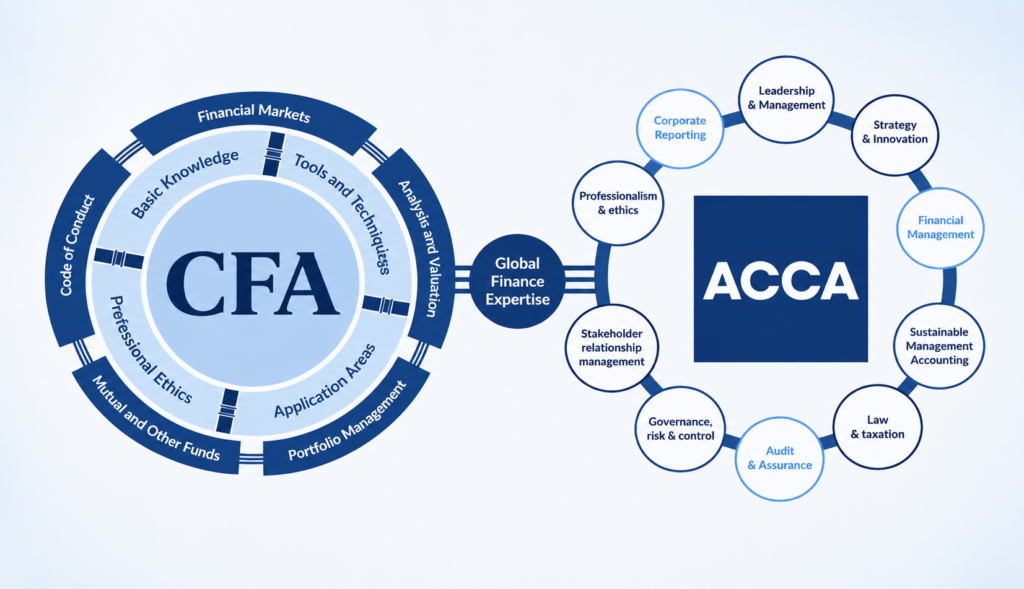
Why Students Choose Professional Finance Qualifications Like ACCA and CFA
In today’s competitive job market, a university degree alone isn’t enough. Employers increasingly look for practical experience, industry expertise, and a working understanding of global financial practices — and that’s exactly the gap ACCA and CFA are designed to close.
1. Global Recognition
Both ACCA and CFA are internationally recognised qualifications that open doors to career opportunities around the world.
- ACCA: An ACCA-qualified accountant can work with multinational companies or accounting firms in countries like the UK, UAE, or Singapore.
- CFA: A CFA charter holder can pursue investment and portfolio management roles with global banks and asset management firms in financial hubs such as New York, London, or Hong Kong.
2. Better Career Opportunities
These qualifications provide specialised knowledge that helps students stand out in a competitive job market.
- ACCA: A B.Com graduate with ACCA may secure roles such as Audit Associate or Financial Accountant in a Big Four firm.
- CFA: A graduate with CFA can begin a career as a Financial Analyst or Equity Research Analyst in an investment company.
3. Higher Earning Potential
As professionals gain experience, ACCA and CFA can lead to senior roles with greater responsibility and higher salaries.
- ACCA: An ACCA professional can progress from Accountant to Finance Manager and eventually become a Chief Financial Officer (CFO).
- CFA: A CFA professional may start as a Financial Analyst and grow into a Portfolio Manager or Chief Investment Officer (CIO).
4. Specialised Expertise
Both qualifications let students specialise in the area of finance they’re most passionate about.
- ACCA: Ideal for students interested in accounting, auditing, taxation, and corporate finance.
- CFA: Best suited to students who enjoy investment analysis, financial markets, wealth management, and portfolio management.
5. Faster Career Growth
Professional qualifications equip students with practical knowledge that helps them take on leadership responsibilities as they gain experience.
- ACCA: An ACCA-qualified professional can move from Accountant to Financial Controller and later become a CFO.
- CFA: A CFA professional can advance from Research Analyst to Portfolio Manager and eventually lead an investment team as a CIO.
Career Paths After ACCA
Accounting and Finance
- Financial Accountant — Prepares financial statements and ensures the company’s financial records are accurate and compliant.
- Management Accountant — Analyses financial data to help management make informed business decisions.
- Cost Accountant — Tracks and controls business costs to improve profitability and operational efficiency.
- Financial Controller — Oversees the organisation’s accounting operations, budgeting, and financial reporting.
- Finance Manager — Manages financial planning, budgeting, cash flow, and the overall financial health of a business.
- Chief Financial Officer (CFO) — Leads the company’s financial strategy and makes high-level decisions to drive business growth.
Audit and Assurance
- External Auditor — Examines a company’s financial statements to ensure they are accurate and comply with regulations.
- Internal Auditor — Reviews internal processes and controls to identify risks and improve business operations.
- Audit Associate — Assists in conducting audits by collecting, analysing, and verifying financial information.
- Compliance Officer — Ensures the organisation follows legal, financial, and regulatory requirements.
Taxation
- Tax Consultant — Advises individuals and businesses on tax planning and compliance.
- Corporate Tax Advisor — Helps companies optimise tax strategies while complying with tax laws.
- GST/VAT Specialist — Manages indirect tax compliance, filings, and advisory services.
- International Tax Consultant — Advises multinational businesses on cross-border taxation and global tax regulations.
Corporate Finance
- Treasury Analyst — Manages cash flow, investments, and liquidity to ensure financial stability.
- Corporate Finance Executive — Supports business expansion by managing investments, funding, and financial planning.
- FP&A (Financial Planning & Analysis) Analyst — Prepares budgets, forecasts, and financial reports to support strategic decisions.
- Business Finance Partner — Collaborates with business teams to improve financial performance and achieve organisational goals.
Risk and Governance
- Risk Consultant — Identifies financial and operational risks and recommends strategies to minimise them.
- Internal Controls Specialist — Designs and monitors systems that safeguard company assets and financial accuracy.
- Governance Officer — Ensures the organisation follows ethical practices and corporate governance standards.
- Enterprise Risk Analyst — Evaluates business-wide risks and develops plans to reduce their impact.
Consulting
- Financial Consultant — Helps clients improve financial performance through strategic advice and planning.
- Business Consultant — Recommends solutions to enhance business efficiency, profitability, and growth.
- Advisory Associate — Assists clients with financial, operational, and regulatory challenges.
- Strategy Consultant — Develops long-term business strategies to improve competitiveness and growth.
Public Sector and Non-Profit Organisations
- Government Finance Officer — Manages public funds, budgets, and financial reporting to ensure transparency and efficient use of government resources.
- Public Finance Consultant — Advises government bodies and public institutions on budgeting, financial planning, policy implementation, and resource allocation.
- NGO Financial Manager — Oversees budgeting, grant management, and financial reporting to ensure donor funds are used effectively and in compliance with regulations.
Emerging Careers (ACCA)
- ESG Reporting Specialist — Helps companies measure and report their environmental, social, and governance (ESG) performance to meet sustainability goals.
- Sustainability Reporting Consultant — Guides organisations in preparing sustainability reports and complying with global ESG reporting standards.
- Forensic Accountant — Investigates financial fraud, detects financial crimes, and helps resolve legal disputes involving money.
- Business Intelligence Analyst — Uses financial and business data to uncover insights that help companies make smarter strategic decisions.
- Financial Systems Consultant — Helps businesses implement and improve financial software and digital accounting systems for greater efficiency.
- Shared Services Finance Specialist — Manages centralised finance functions such as accounting, payroll, and reporting for multiple business units or global offices.
Career Paths After CFA
Investment Banking
- Investment Banking Analyst — Helps companies raise capital, manage mergers and acquisitions, and make major financial decisions.
- Mergers & Acquisitions (M&A) Analyst — Evaluates and manages business mergers, acquisitions, and strategic deals.
- Corporate Finance Analyst — Analyses a company’s financial performance to support investment and business growth decisions.
Asset Management
- Portfolio Manager — Manages clients’ investments to maximise returns while balancing risk.
- Fund Manager — Makes investment decisions for mutual funds or other investment funds to achieve the best possible returns.
- Investment Manager — Develops investment strategies to help individuals and organisations grow their wealth.
Equity Research
- Equity Research Analyst — Studies companies and industries to recommend which stocks are worth buying, holding, or selling.
- Securities Analyst — Evaluates financial securities such as stocks and bonds to identify profitable investment opportunities.
- Investment Research Associate — Collects and analyses financial and market data to support investment recommendations.
Wealth Management
- Wealth Advisor — Helps individuals grow, manage, and protect their wealth through personalised financial advice.
- Financial Planner — Creates customised financial plans covering savings, investments, taxes, and retirement goals.
- Relationship Manager — Builds long-term client relationships while offering tailored financial and investment solutions.
- Private Banker — Provides exclusive banking and investment services to high-net-worth individuals.
Risk Management
- Risk Analyst — Identifies potential financial risks and develops strategies to protect businesses and investments.
- Credit Risk Analyst — Assesses whether individuals or companies are financially capable of repaying loans.
- Market Risk Analyst — Monitors market trends and evaluates how economic changes could impact investments.
Capital Markets
- Equity Dealer — Buys and sells stocks on behalf of clients or financial institutions to maximise returns.
- Fixed Income Analyst — Analyses bonds and other debt securities to identify stable investment opportunities.
- Derivatives Analyst — Studies financial derivatives to manage risk and improve investment performance.
- Commodity Analyst — Tracks commodity markets such as gold, oil, and agricultural products to identify investment trends.
Alternative Investments
- Hedge Fund Analyst — Researches investment opportunities and supports strategies to generate high returns for hedge funds.
- Private Equity Associate — Evaluates private companies for investment and helps improve their value before they are sold.
- Venture Capital Analyst — Identifies promising startups with strong growth potential and recommends investment opportunities.
FinTech
- Financial Data Analyst — Uses financial data and analytics to help businesses make smarter financial decisions.
- Investment Technology Consultant — Helps financial firms adopt modern technologies to improve investment processes and client services.
- Quantitative Analyst (Quant) — Uses mathematics, statistics, and programming to develop models that guide investment and trading decisions.
Emerging Careers (CFA)
- ESG Investment Analyst — Evaluates companies based on their environmental, social, and governance (ESG) practices to help investors make responsible investment decisions.
- Sustainable Finance Consultant — Helps businesses and investors develop financial strategies that support sustainability and long-term growth.
- FinTech Investment Analyst — Analyses investment opportunities in innovative financial technology companies transforming the future of finance.
- Cryptocurrency Research Analyst — Studies digital assets like cryptocurrencies and blockchain trends to identify emerging investment opportunities.
- Behavioral Finance Analyst — Examines how human emotions and psychology influence investment decisions and financial markets.
- Quantitative Research Analyst (Quant Researcher) — Uses data, mathematics, and advanced analytics to build models that support smarter investment and trading decisions.

One of the best things about pursuing ACCA is that you’re not confined to a single job or industry. As you build your knowledge in finance and accounting, you’ll find opportunities across auditing, taxation, consulting, banking, financial planning, risk management, and business advisory. That flexibility is exactly why ACCA remains such a popular choice among students who want to keep their career options open — and why leading employers like Deloitte, PwC, EY, KPMG, HSBC, Procter & Gamble, Unilever, Nestlé, Shell, TCS, Infosys, and Reliance Industries actively hire ACCA professionals. Whether you dream of working with a Big Four firm, joining the finance team of a global brand, or helping businesses make smarter financial decisions, ACCA gives you the knowledge and practical skills to get started — and a qualification recognised worldwide, wherever your ambitions take you.

For those passionate about financial markets, investments, and strategic decision-making, the CFA qualification opens the door to a wide range of exciting career opportunities. Unlike traditional accounting qualifications, CFA focuses on investment management, portfolio analysis, equity research, wealth management, corporate finance, and risk analysis — making it the natural choice for anyone building a career in the investment industry. This specialised expertise is valued by some of the world’s leading financial institutions, including Goldman Sachs, JPMorgan Chase, Morgan Stanley, BlackRock, Vanguard, PIMCO, Bank of America, and Citibank, which recruit CFA professionals for roles analysing markets, evaluating investment opportunities, managing portfolios, and advising clients on financial strategy. Whether you aspire to work in investment banking, asset management, private equity, or financial consulting, the CFA qualification provides a strong foundation recognised globally for its analytical rigour, ethical standards, and investment expertise.
In Retrospect
At the heart of every successful finance career is a willingness to learn, adapt, and keep moving forward. ACCA and CFA are more than professional qualifications — they’re opportunities to develop specialised skills, solve real-world financial challenges, and make a meaningful impact in the career you choose. Whether your passion lies in accounting and business, or in investments and financial markets, each qualification offers a unique path towards professional growth. The destination may be different, but the opportunity to build a rewarding, respected, and fulfilling career is something they both have in common. Choose the path that inspires you, stay curious, and let your passion shape the future you want to create.