


I. Macro Valuation: Assessing the Global Investment Landscape
Aspiring finance professionals face a highly fragmented credentialing landscape when targeting high-yield careers in corporate finance, asset valuation, and buy-side portfolio management. Traditional domestic licensing tracks (such as local accounting or legal qualifications), while carrying deep statutory power within local domestic borders, frequently lack cross-border portability. This geographic restriction creates career friction, requiring expensive and time-consuming re-qualification when crossing international borders.
Furthermore, traditional graduate-level business credentials often present significant barriers. Pursuing a high-quality Master of Business Administration (MBA) from a top-tier business school typically requires a full-time, two-year career break, demanding a substantial upfront financial investment with tuition fees at premier institutions ranging from ₹15 Lakhs to ₹25 Lakhs. For many candidates, the high direct tuition cost is compounded by a massive opportunity cost in the form of forgone corporate salaries during the academic hiatus.
The Chartered Financial Analyst (CFA) program, administered globally by the CFA Institute, resolves these barriers by offering a globally unified, self-paced, and standardized credentialing pathway. The program enforces a single, standardized curriculum worldwide, ensuring that candidates are evaluated against the same absolute technical benchmarks regardless of geographic location.
However, candidates must recognize the practical differences in local practice rights. In India, only members of the Institute of Chartered Accountants of India (ICAI) hold statutory audit signing authority under the Companies Act 2013. A CFA charterholder cannot sign local corporate audit reports or certify statutory tax filings. Despite this limitation, graduates are highly sought after by multinational corporations (MNCs), investment banks, corporate advisory desks, and the global capability networks of the Big 4 firms, where the focus lies on international reporting (IFRS), global portfolio analytics, valuation modeling, and cross-border consolidations.
| Professional Education Track | Career Interruption Requirement | Typical Tuition/Exam Fees (INR) | Primary Domain Focus |
| Traditional Tier-1 MBA | Mandatory 1-2 Year Career Break | ₹1,500,000 to ₹2,500,000+ | Broad business administration, leadership, and cross-functional management. |
| Chartered Financial Analyst (CFA) | Zero (Designed for active part-time study) | ₹350,000 to ₹450,000 (All-in exam costs) | Specialized asset valuation, quantitative analysis, and portfolio construction. |
II. Timeline & Entry Pathway Roadmap
To enter the CFA Program, candidates must satisfy specific academic or professional gates.
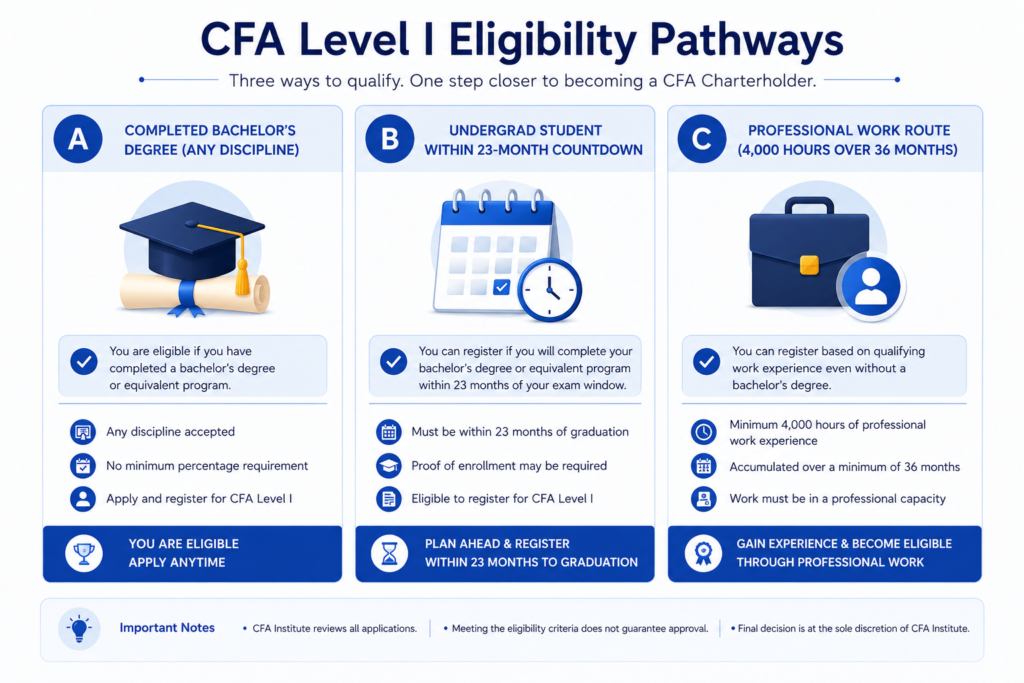
The countdown framework for undergraduate student registration is highly specific:
Level I Registration: A student’s chosen exam window must fall 23 months or fewer before their graduation month. This allows students in the second year of a standard three-year Indian degree (or the third year of a four-year degree) to sit for the Level I exam.
Level II Registration: The student must be within 11 months of their graduation month at the time of the exam.
Level III Registration: Undergraduates are not eligible to register or sit for the final level. Candidates must have completed their bachelor’s degree and hold an official graduation certificate before registering.
Alternatively, candidates without a degree can qualify via the Professional Experience Route, which requires a combination of 4,000 hours of professional work experience and/or higher education accumulated over at least three sequential years (36 months) before registering for Level I. The work experience does not need to be investment-related, but must be professional and paid, requiring specialized knowledge, judgment, and analytical skills.
Core Non-Negotiable Conditions
The Travel Passport Mandate: A valid, unexpired international travel passport is the only acceptable form of identification for both exam registration and testing center entry. Alternative identification (such as Aadhaar, PAN cards, or driver’s licenses) is not accepted.
English Proficiency: Exams are administered only in English, requiring strong reading comprehension to interpret dense financial scenarios.
Attempt Limits and the Six-Month Rule: Candidates are limited to a maximum of six total attempts per exam level. Sittings cannot be booked in consecutive windows, requiring a minimum of six months between attempts.
III. Technical Architecture: Level-by-Level Syllabus and Exam Patterns
The CFA Program is divided into three progressive levels that candidates must pass sequentially.
1. Level I: Foundations of Asset Valuation and Investment Tools
The Level I curriculum establishes foundational knowledge, focusing on basic concepts, definitions, and analytical tools across ten core topic areas. The exam is administered in a computer-based testing (CBT) format consisting of 180 stand-alone, three-choice multiple-choice questions split evenly across two sessions. Each session is 2 hours and 15 minutes long, giving candidates an average of 90 seconds per question.
The 2026 Level I curriculum maintains complete stability compared to 2025, carrying forward all 93 learning modules and 365 Learning Outcome Statements (LOS) without updates.
| Level I Topic Area | 2026 Weighting | Est. Questions (of 180) | Strategic Priority & Focus |
| Ethical & Professional Standards | 15–20% | 27–36 | Critical; serves as the primary tie-breaker at the MPS boundary. |
| Financial Statement Analysis (FSA) | 11–14% | 20–25 | High priority; tests cash flow quality, income statements, and balance sheets. |
| Equity Investments | 11–14% | 20–25 | High priority; covers market structures and foundational valuation models. |
| Fixed Income | 11–14% | 20–25 | High priority; covers bond yield structures, pricing, and duration math. |
| Portfolio Management | 8–12% | 14–22 | Medium priority; covers basic diversification and CAPM models. |
| Alternative Investments | 7–10% | 13–18 | Medium priority; covers hedge funds, real estate, and commodities. |
| Economics | 6–9% | 11–16 | Medium priority; covers business cycles, monetary policies, and FX markets. |
| Quantitative Methods | 6–9% | 11–16 | Medium priority; covers TVM, statistics, and hypothesis testing. |
| Corporate Issuers | 6–9% | 11–16 | Medium priority; covers capital structure and corporate governance. |
| Derivatives | 5–8% | 9–14 | Lower priority; covers basic option and forward contracts. |
The 2027 Level I Curriculum Shift
For candidates targeting sittings beginning in February 2027, the Level I curriculum undergoes a major restructuring representing approximately 25% of the exam:
Topic Rebranding: Corporate Issuers is renamed Corporate Finance, Equity Investments becomes Equities, and Portfolio Management is rebranded as Portfolio Construction.
Weight Adjustments: Level I weights change to Quantitative Methods (11–14%), Derivatives (6–9%), Alternative Investments (6–9%), and Ethical and Professional Standards (10–15%).
Financial Data Science and AI Integration: The Quantitative Methods section will cover estimation, simulation, optimization, financial data science, AI, and Large Language Models (LLMs).
Valuation Modeling: Equities will focus on practical analyst workflows, disaggregated modeling, scenario analysis, and estimating the cost of equity.
Ethical Standards: The standalone Global Investment Performance Standards (GIPS) reading is removed, with the curriculum focusing on Standards of Professional Conduct I–VII to help candidates prevent ethical violations.
Equation Explorers: Interactive digital learning tools will be introduced to help candidates master core mathematical relationships, including the time value of money, implied returns, and cash flows.
2. Level II: Deep Asset Valuation and Vignette-Based Execution
The Level II exam shifts focus from foundational recall to asset valuation, pricing, and the practical application of theories under complex conditions. The exam is 4 hours and 24 minutes long, divided into two sessions of 2 hours and 12 minutes. It consists of 22 vignette-based item sets (11 per session) containing 88 multiple-choice questions. Candidates must read a multi-page vignette describing a corporate scenario and answer 4 to 6 integrated questions based on it. Each question carries 3 points, with no negative marking.
The only curriculum update for 2026 is the deletion of a single Learning Outcome Statement (LOS) on machine learning in the Quantitative Methods section.
| Level II Topic Area | 2026 Weighting | Evaluation Focus & Structural Demands |
| Ethical & Professional Standards | 10–15% | Application of Code and Standards to complex corporate situations. |
| Financial Statement Analysis | 10–15% | Multi-corporate reporting, inter-corporate investments, and post-employment benefits. |
| Equity Investments | 10–15% | Advanced equity valuation; covers DCF, dividend discount, and residual income models. |
| Fixed Income | 10–15% | Bond pricing with embedded options, credit risk modeling, and term structures. |
| Portfolio Management | 10–15% | Multi-factor models, active portfolio management, and trading execution cost metrics. |
| Corporate Issuers | 5–10% | Capital structure decisions, corporate financing, and M&A modeling. |
| Quantitative Methods | 5–10% | Multiple regression analysis and advanced financial forecasting techniques. |
| Economics | 5–10% | Currency exchange rate forecasting and economic growth models. |
| Derivatives | 5–10% | Pricing and valuation of options, swaps, forwards, and futures. |
| Alternative Investments | 5–10% | Private equity valuation, illiquid assets, and infrastructure investing. |
3. Level III: Portfolio Management, Wealth Planning, and Pathway Specialization
The Level III exam tests portfolio construction, asset allocation, and wealth planning. The exam is 4 hours and 24 minutes long, consisting of 22 sets split between vignette-based item sets and constructed-response essay questions. Unlike earlier formats, essay and item sets are mixed across both sessions to balance cognitive demand.
Starting in the 2025 and 2026 cycles, Level III candidates must choose one of three specialized pathways. This pathway-specific content accounts for 30% to 35% of the exam, while the remaining 65% to 70% is dedicated to a shared core curriculum.
| Level III Subject (Core + Pathway) | Weighting | Focus Areas & Learning Outcome Goals |
| Selected Pathway Content | 30–35% | Detailed study of the chosen pathway (PM, PW, or Private Markets). |
| Asset Allocation | 15–20% | Strategic and tactical asset allocation under real-world constraints. |
| Portfolio Construction | 15–20% | Investment Policy Statement (IPS) formulation and execution. |
| Derivatives & Risk Management | 10–15% | Derivatives-based hedging, overlay strategies, and risk budgeting. |
| Ethical & Professional Standards | 10–15% | Application of GIPS and professional code in portfolio scenarios. |
| Performance Measurement | 5–10% | Performance attribution, benchmarking, and manager selection. |
Pathway 1: Portfolio Management: The traditional pathway, ideal for public equity asset management, fixed-income portfolio management, and buy-side research. It covers index-based equity strategies, active equity portfolio construction, and yield curve strategies.
Pathway 2: Private Wealth: Tailored for private banking, wealth advisory, and family office careers. It focuses on individual investor goals, behavioral finance, estate planning, trust structuring, and tax-optimized wealth preservation.
Pathway 3: Private Markets: Designed for private equity, venture capital, private debt, real estate, and infrastructure investments. It covers private structures, general partner (GP) and limited partner (LP) dynamics, and the valuation of illiquid assets.
IV. Specialized Execution: Level III Pathways and Applied Skills Integration (PSM)
To bridge academic theory with real-world financial requirements, the CFA Institute requires candidates to complete at least one Practical Skills Module (PSM) at each exam level. Each PSM requires a 10 to 20 hour commitment, combining instructional videos, guided coding or spreadsheet exercises, and case assessments. A PSM must be fully completed by the official results release date; if a candidate fails to complete it in time, their exam score is voided, requiring a full retake. Only one PSM is required per level, and a candidate cannot repeat the same module at subsequent levels.
| CFA Level | 2026 PSM Selection Matrix | Developed Skillsets & Deliverables |
| Level I | Financial Modeling; Python Programming Fundamentals | Build a functional 3-statement corporate valuation in Excel. Learn basic Python coding, Jupyter Notebooks, and data visualization. |
| Level II | Python Programming Fundamentals; Python, Data Science, and AI; Equity Analyst Skills | Learn financial data science, machine learning models, and forecasting. Apply valuation techniques, write initiation reports, and pitch ideas. |
| Level III | Portfolio Development & Construction; Practical Macro / Due Diligence; Managing Private Wealth Clients | Construct and manage institutional portfolios using advanced Excel. Learn private equity transactions, private market ethics, and estate planning. |
V. Budgeting and Financial Engineering: The 2026-2027 Fee Matrices
The CFA Institute restructured its pricing model for all sittings starting in 2026, permanently eliminating the one-time USD 350 enrollment fee to lower the entry barrier for new candidates. However, to offset this, individual exam registration fees were raised across all levels. This shift reduces upfront costs for candidates who pass on their first attempt, but increases the long-term cost for those who require multiple attempts.
Core Administrative and Exam Fees
CFA registration fees are divided into two periods: Early and Standard. Booking during early windows provides significant savings. Indian candidates must also pay an additional 18% Goods and Services Tax (GST) on all transaction fees paid directly to the CFA Institute.
| Fee Component Type | 2025 Cost (USD) | 2026 Cost (USD) | Est. INR Cost (Excl. GST) | Strategic Notes & Deadlines |
| One-Time Program Enrollment | $350 | $0 | ₹0 | Permanently eliminated to lower initial entry barriers. |
| Level I & II Early Booking | $990 | $1,140 | ~₹98,470 | Closes approximately 7 months prior to the exam month. |
| Level I & II Standard Booking | $1,290 | $1,490 | ~₹1,28,830 | Standard deadline; closes 3 months prior to the exam month. |
| Level III Early Booking | $1,090 | $1,240 | ~₹1,11,540 | Closes approximately 7 months prior to the exam month. |
| Level III Standard Booking | $1,390 | $1,590 | ~₹1,37,480 | Standard deadline; closes 3 months prior to the exam month. |
| Exam Rescheduling Surcharge | $250 | $250 | ~₹21,500 | Charged to change a date or test center within the window. |
Failing an exam carries a high financial penalty. Re-sitting a failed exam requires paying the full registration fee again ($1,140 to $1,590 depending on timing), plus 18% GST and any costs for updated study materials.
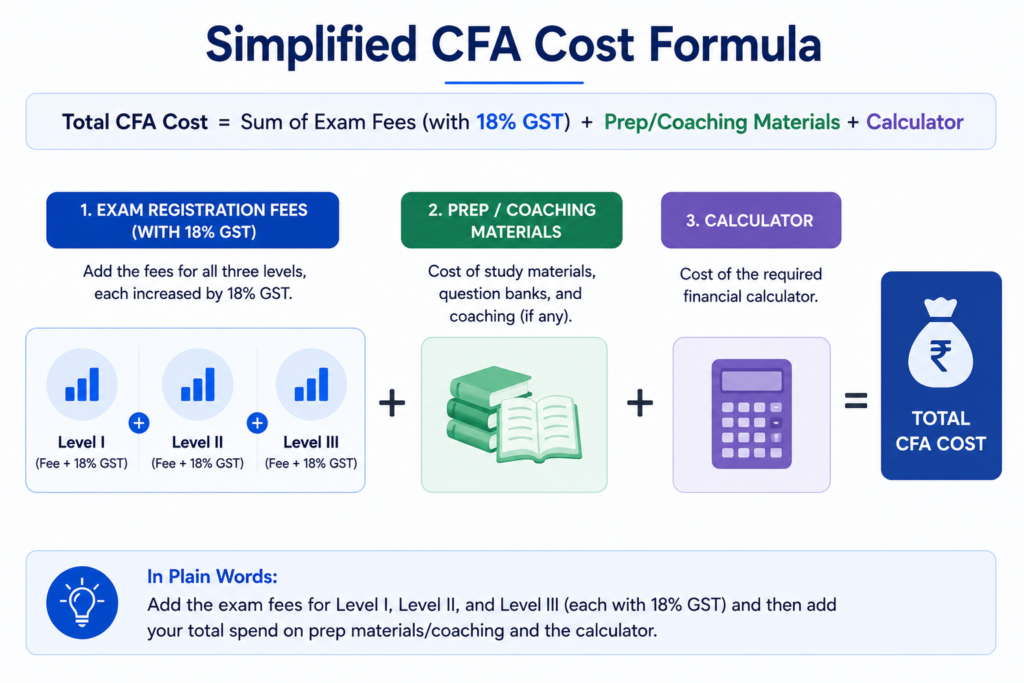
For a candidate utilizing foreign premium support options, such as the Quartic study packages, academic costs scale as follows:
| Quartic Academic Support Tier | Tuition Fee (GBP) | Est. Rupee Value (Excl. VAT) | Materials & Resources Included |
| CFA Level I/II Core Package | £950 / £995 | ~₹104,500 / ₹109,450 | On-demand classes, question banks, mocks, and tutor support. |
| CFA Level I/II Premier Package | £1,695 / £1,795 | ~₹186,450 / ₹197,450 | Tutor-guided study, mock exams, and unlimited email support. |
| CFA Level I/II Exec Mentoring | £4,000+ | ~₹440,000+ | Bespoke, tutor-led learning and individual mentoring. |
| CFA Supplementary Books Only | £400 | ~₹44,000 | Core physical text books and study summaries. |
| CFA Supplementary Q-Banks Only | £400 | ~₹44,000 | Comprehensive online practice problems and analytics. |
| CFA Final Stage Mock Exams Only | £50 | ~₹5,500 | Full-length timed practice exams and grading debriefs. |
VI. High-Stakes Performance: De-masking Pass Rates and the “Deferral Drag”
Many coaching centers advertise exceptionally high student pass rates to attract enrollments. However, official CFA Institute data reveals a more demanding reality, with pass rates typically hovering between 39% and 50%.
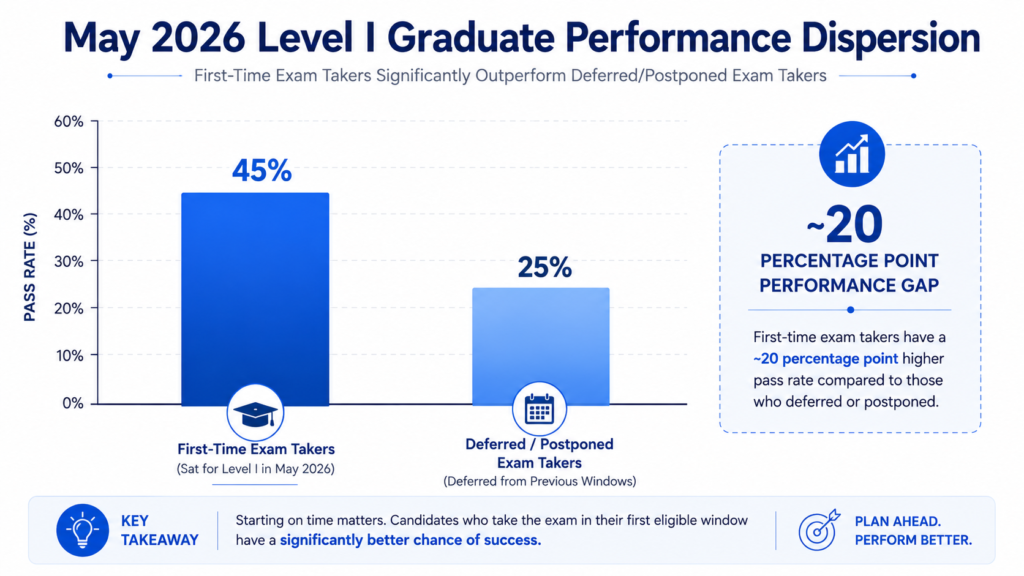
A major self-inflicted wound in the performance data is the postponement of exams. Postponing an exam breaks study momentum and is strongly correlated with lower pass rates. Across all levels, first-time takers outpass deferred candidates by approximately 20 percentage points.
⚠️ Note: the specific comparison in this section (May 2026 Level II pass rate of 43%, described as “below May 2025’s exceptionally high result of 54%”) should be independently verified against the official CFA Institute pass-rate announcement before publishing, since it is a precise, checkable statistic.
| Exam Window | Overall Global Pass Rate | First-Time Candidate Pass Rate | Deferred Candidate Pass Rate | Historical Trend & Context |
| May 2026 (Level I) | 39% | 45% | 25% | Performance aligns with the 10-year average of 40%. |
| May 2026 (Level II) | 43% | 52% | 28% | Below May 2025’s exceptionally high result of 54%. |
| February 2026 (Level I) | 45% | 50% | 30% | Stronger showing, driven by a highly prepared cohort. |
| February 2026 (Level III) | 50% | 59% | 34% | Aligns with the 10-year Level III average of 51%. |
| November 2025 (Level I) | 43% | 49% | 27% | Typical performance for the late-year window. |
| November 2025 (Level II) | 42% | 50% | 26% | Underlined by a high volume of deferred candidates. |
| August 2025 (Level II) | 44% | 52% | 28% | Aligns closely with the 5-year average of 46%. |
| August 2025 (Level III) | 50% | 59% | 34% | Stable performance, typical of computer-based testing. |
To transition from an exam passer to a full charterholder, candidates must also fulfill the Professional Experience Requirement (PER). Candidates must complete at least 4,000 hours of qualified work experience over a minimum of 36 months, which can be completed before, during, or after passing the exams. This experience must be directly involved in the investment decision-making process or producing work that adds value to it, such as equity research, portfolio analytics, risk management, or corporate valuation modeling.
VII. Capitalizing the Yield: Career ROI, Milestone Compensation, and Metro Indices in India
The CFA credential provides a strong return on investment in the corporate sector, with starting salaries that compare favorably to non-certified commerce graduates. Salaries scale significantly as candidates pass exam milestones and gain relevant work experience:
| Exam Milestone / Experience | Annual Salary Range (INR) | Average Monthly Gross | Common Job Roles & Target Functions |
| Level I Passed (Fresher / 0–2 Yrs) | ₹5.0 LPA to ₹8.0 LPA | ₹41,000 – ₹67,000 | Research Associate, Junior Credit Analyst, Valuation Associate, Risk Analyst. |
| Level II Passed (Junior / 2–4 Yrs) | ₹12.0 LPA to ₹17.0 LPA | ₹100,000 – ₹141,000 | Senior Analyst, Credit Risk Specialist, Valuation Associate, M&A Analyst. |
| CFA Charterholder (Mid-Career / 5–8 Yrs) | ₹20.0 LPA to ₹40.0 LPA | ₹167,000 – ₹333,000 | Portfolio Manager, Investment Banker, Senior Risk Specialist, Wealth Lead. |
| Senior Domain Expert (Executive / 10+ Yrs) | ₹50.0 LPA to ₹1.0+ Crore | ₹417,000 – ₹833,000+ | Chief Financial Officer (CFO), Chief Investment Officer (CIO), VP Finance, PE Partner. |
Compensation Trajectories by Corporate Job Function
Investment Banking & M&A Advisory: Junior analysts focus on pitch books, market research, and deal structures, with starting salaries of ₹9.0 to ₹12.0 LPA. Senior execution specialists routinely command ₹25.0 to ₹50.0+ LPA, excluding transactional performance bonuses.
Portfolio & Asset Management: Portfolio tracks typically start around ₹15.0 LPA, while senior fund managers responsible for multi-asset allocations command ₹30.0 to ₹50.0+ LPA.
Equity Research & Valuations: Analysts evaluate competitive advantages and issue corporate recommendations, with entry-level salaries of ₹6.0 to ₹9.0 LPA and senior coverage analysts earning ₹16.0 to ₹30.0 LPA.
Credit & Risk Management: Roles involve covenant evaluation, risk policy formulation, and risk modeling, with typical packages ranging from ₹6.0 to ₹14.0 LPA for analysts and reaching ₹10.0 to ₹25.0 LPA for senior risk managers.
Private Wealth Management: Wealth advisory roles start at ₹6.0 LPA, scaling up to ₹20.0 LPA based on the advisor’s client book and asset under management (AUM) retention rates.
City-Wise Salary Index and Cost of Living Dynamics
Salaries vary across Indian cities, driven by the concentration of financial institutions and living costs:
| Metro Location | Earning Index | Avg. Entry-Level Pay | Avg. Mid-Career Pay | Primary Focus & Employer Segment |
| Mumbai | 115 | ₹6.0 – ₹10.0 LPA | ₹15.0 – ₹30.0 LPA | High concentration of buy-side firms, investment banks, and PE funds. |
| Bengaluru | 108 | ₹5.5 – ₹9.0 LPA | ₹12.0 – ₹25.0 LPA | High concentration of Global Capability Centers and alternative investment firms. |
| Delhi-NCR | 105 | ₹5.0 – ₹8.5 LPA | ₹11.0 – ₹22.0 LPA | Large corporate operations, consulting firms, and wealth offices. |
| Pune | 98 | ₹4.5 – ₹7.5 LPA | ₹9.0 – ₹18.0 LPA | Focus on GCC operations, risk analytics hubs, and asset support teams. |
| Hyderabad | 95 | ₹4.5 – ₹7.0 LPA | ₹8.5 – ₹16.0 LPA | Focus on banking centers, investment research support, and advisory groups. |
| Chennai | 90 | ₹4.0 – ₹6.5 LPA | ₹8.0 – ₹15.0 LPA | Focus on analytics desks, shared services networks, and rating firms. |
Compensation Variation by Employer Segment
Global Capability Centers (GCCs): Operations run by global financial entities (e.g., JP Morgan, Goldman Sachs, HSBC) offer starting salaries of ₹9.0 to ₹12.0 LPA, focusing on cross-border consolidations, portfolio risk modeling, and advanced quantitative research.
The Big 4 Consulting Firms: Offer starting salaries of ₹6.0 to ₹10.0 LPA. While initial packages are lower, they provide clear promotional tracks every 2 to 3 years and strong long-term market credibility.
Buy-Side Venture Capital & Private Equity Funds: Niche and highly competitive, typically requiring prior transaction experience. Senior-level packages routinely exceed ₹1.0 Crore, driven by variable performance carry and deal bonuses.
VIII. Tactical Competence: Comparison Matrix and Preparation Strategy
Choosing a professional qualification depends on career goals, budget, and geographic focus.
| Feature Metric | CFA (USA) | Indian CA (ICAI) | US CPA (USA) | FRM (GARP) |
| Primary Region | Global (160+ countries) | India | USA & US Multinationals | Global (Bank networks) |
| Syllabus Core | Asset valuation & portfolio construction. | Indian accounting standards, tax codes, and audit law. | US GAAP, US federal tax codes, and audit frameworks. | Financial risk modeling, credit risk, and Basel rules. |
| Exam Layout | 3 progressive levels. | 3 levels (Foundation, Intermediate, Final). | 4 exam sections. | 2 progressive parts. |
| Avg. Pass Rate | 39% – 50% | 10% – 15% (Final level) | 45% – 55% | 45% – 55% |
| Timeline | 2 to 4 Years (Part-time) | 4 to 5 Years (Inc. articleship) | 1 to 2 Years (Part-time) | 1 to 1.5 Years (Part-time) |
| Statutory Rights | None in India. | Full statutory audit and tax signing rights in India. | None in India; audit signing rights in the US. | None. |
| All-In Cost | ₹3.5 Lakh – ₹4.5 Lakh | ₹2.0 Lakh – ₹4.0 Lakh | ₹3.5 Lakh – ₹5.0 Lakh | ₹1.35 Lakh – ₹1.60 Lakh |
| Starting Salary | ₹6.0 LPA – ₹12.0 LPA | ₹8.0 LPA – ₹15.0 LPA | ₹6.0 LPA – ₹10.0 LPA | ₹6.0 LPA – ₹12.0 LPA |
Subject-Wise Study Sequencing and Time Allocation
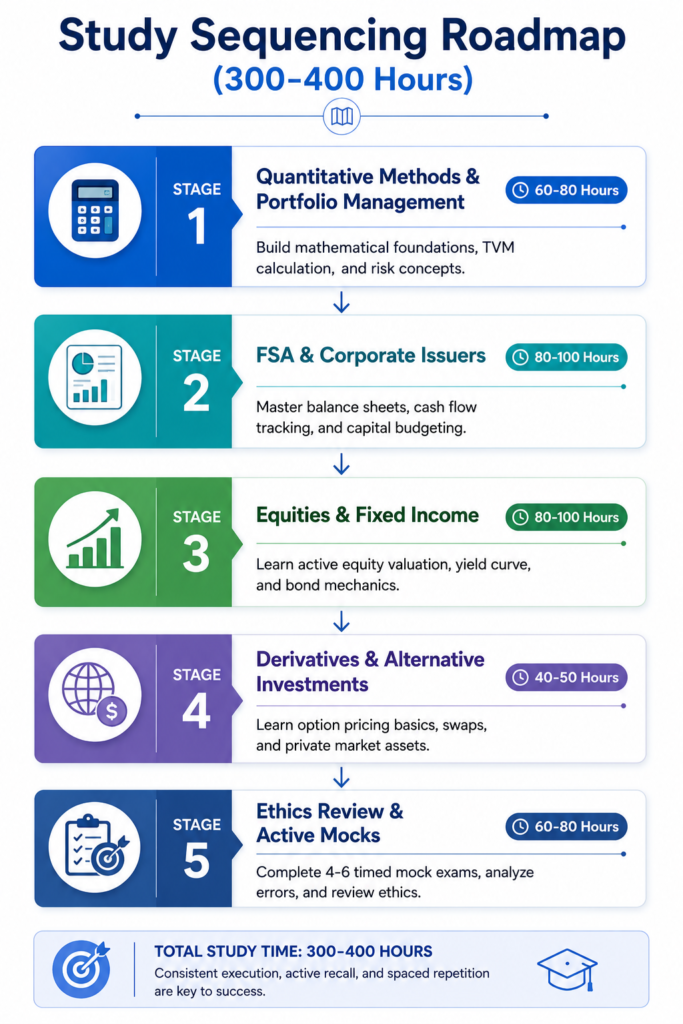
To manage the study workload, candidates should structure their preparation systematically, using an orderly progression:
Because half of the points on the Level III exam come from constructed-response essay questions, mastering this written format is essential. Many candidates struggle with written essay questions, making structured practice crucial. To support candidates, Proschool structures its Level III prep program into a 22-week plan:
Weekly Graded Essay Workshops: Saturday study sessions include a 2-hour, exam-format essay workshop. Candidates complete a 60-minute solo solve of two essay prompts under exam conditions.
Personalized Graded Feedback: Instructors debrief the essay prompts and provide handwritten, individual feedback within 72 hours, helping candidates refine their writing structure and time management.
IX. Frequently Asked Questions
Can a candidate register for the CFA exams without holding a university degree?
Yes. Under the professional work experience alternative route, candidates who do not hold an undergraduate degree can register for Level I if they have at least 4,000 hours of professional, paid work experience accumulated over a minimum of three sequential years (36 months) before registration. The work does not need to be finance-related, but must involve professional analytical duties and judgment.
Is there a maximum limit on exam attempts within the CFA Program?
Yes. The CFA Institute enforces a strict limit of six total attempts per exam level. If a candidate is unable to clear a level within six attempts, they are permanently ineligible to register or test further within the program. Additionally, sittings must be separated by a minimum of six months.
What happens if the name on a candidate’s passport does not match their CFA account?
If the name on the candidate’s CFA account does not exactly match their valid international travel passport, the candidate will be denied entry to the testing room. This results in the forfeiture of the registration fee, and the candidate must pay the full fee again to register for a future window. Candidates can request corrections through the official name-change portal on the CFA Institute website.
What is the Minimum Passing Score (MPS) and how is it determined?
The Minimum Passing Score (MPS) is the minimum score required to pass a specific exam sitting. It is determined after each exam window using a criterion-referenced process where a panel of charterholders establishes a passing threshold based on exam difficulty, rather than a relative curve or a pre-determined quota of passing candidates. While the exact MPS is not published, historical data indicates it typically sits between 60% and 70% across all levels.
How does a deferral affect a candidate’s likelihood of passing?
A deferral is often a leading indicator of an incomplete study plan. Official performance data demonstrates that postponement is strongly associated with lower pass rates. Across all levels, first-time takers consistently outpass deferred candidates by approximately 20 percentage points. Maintaining consistent study momentum is key to passing the exams.
X. Summary and Call to Action
The CFA Program provides a globally recognized pathway for commerce graduates and finance professionals targeting international careers in investment banking, portfolio management, and private markets. While the credential does not grant local statutory audit signing rights in India, its rigorous curriculum and global alignment make graduates highly valued by multinational corporations, investment banks, and Global Capability Centers (GCCs).
To optimize preparation and manage costs, candidates should focus on three key actions:
Lowering the Failure Surcharge: Registering during early bird windows saves USD 350 per level. Candidates should establish a consistent, structured study program of 300 to 400 hours per level and avoid deferrals, which are statistically linked to lower pass rates.
Diligently Fulfilling PSM Requirements: Candidates must complete their mandatory Practical Skills Modules (PSM) before the results release date to prevent their exam scores from being voided, selecting a different topic at each level.
Pairing Technical Concepts with Data Tools: In today’s investment market, pairing the CFA credential with data visualization and analytical tools (such as Python, Excel modeling, and PowerBI) provides a distinct competitive advantage.
For those ready to take the next step, verifying academic or student eligibility under the 23-month countdown rule, checking passport validity, and registering during an early-bird window are excellent starting points to launch a global finance career.