



Many commerce students dream of building an international accounting career, but choosing the right qualification can be confusing. Among the most recognized global certifications, ACCA stands out because it is accepted in over 180 countries and opens opportunities across audit, taxation, consulting, and financial management. In this guide, we’ll explain everything you need to know-from eligibility and fees to salary, syllabus, and career opportunities.
The Strategic Dilemma in Global Finance Education
Aspiring finance professionals face a highly fragmented educational landscape when pursuing an elite international career. Traditional accounting credentials, while offering deep statutory authority within local borders, frequently lack the cross-border portability required by modern multinational corporations (MNCs) and Global Capability Centers (GCCs). This creates a geographical barrier for ambitious commerce graduates, as localized credentials often require extensive and expensive re-qualification processes when crossing borders.
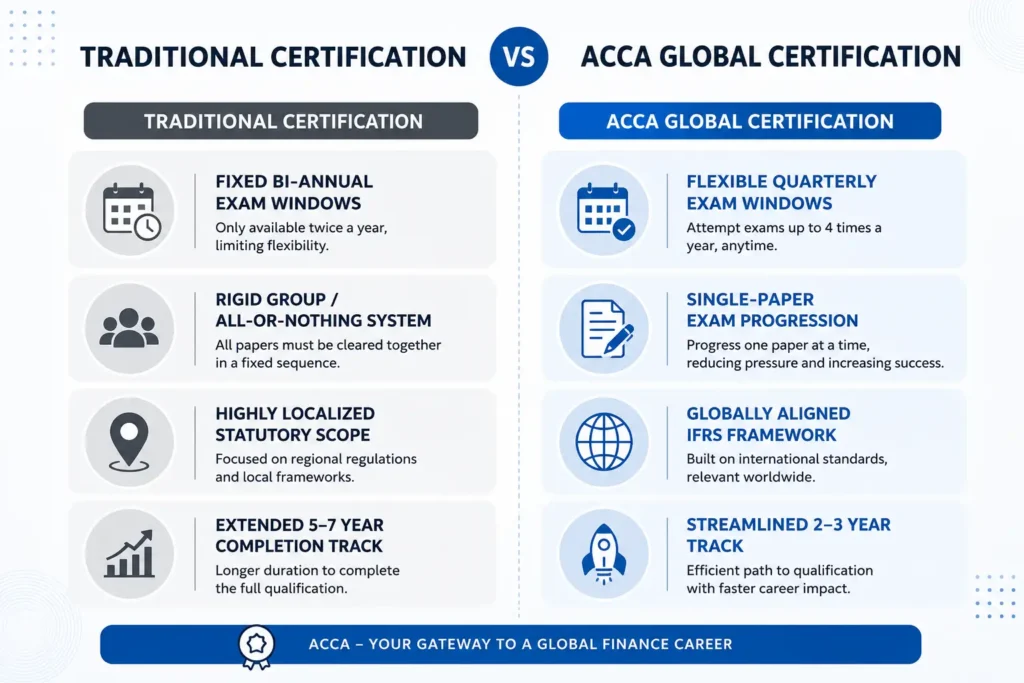
Furthermore, traditional preparation models are often defined by rigid structures, annual or bi-annual testing windows, and “one-shot” group systems where a single failed paper can invalidate an entire semester of work. This high-stress environment leads to prolonged completion timelines, with many candidates spending five to seven years attempting to clear their professional requirements.
The corporate landscape has also evolved past simple bookkeeping and compliance. Today’s multinational enterprises require strategic advisors who understand international consolidation, advanced risk management, and the ethical implications of financial technologies. Localized educational paths often fail to cover these areas, leaving a skills gap that training institutes struggle to address with standard curricula. Candidates are left with a difficult choice: commit to a lengthy, local qualification with limited international reach, or seek an alternative that offers both global recognition and academic flexibility
The ACCA Course as a Frictionless Passport
The ACCA Course addresses these challenges by offering a structured pathway to global mobility. Administered by the Association of Chartered Certified Accountants, this qualification aligns its curriculum with International Financial Reporting Standards (IFRS), ensuring its graduates can step into corporate roles worldwide without needing local re-certification. This makes it a valuable credential for those targeting careers in the United Kingdom, the Middle East, Singapore, Canada, and Australia.
- Accepted across 180+ countries globally
- Direct curricular alignment with IFRS frameworks
- Flexible, single-paper quarterly examination structures
- Integrated Ethics and Professional Skills Module (EPSM)
- Practical Experience Requirement (PER) focused on competency
The program’s structure is highly flexible, allowing candidates to sit for exams individually during quarterly testing windows. This single-paper progression lowers the pressure of “all-or-nothing” systems, enabling working professionals to balance their studies with their careers. By combining core technical knowledge with practical, hands-on experience, the qualification serves as a practical blueprint for building an international corporate finance career.
Technical Architecture: Course Levels and 2026 Syllabus
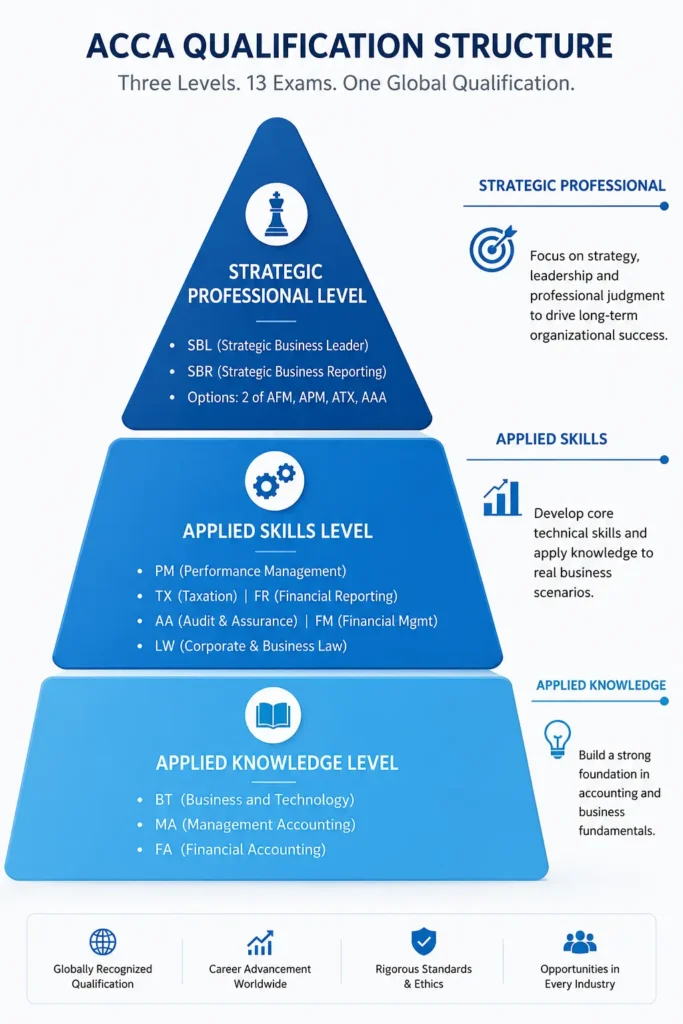
The curriculum is structured into three progressive tiers containing thirteen core papers, designed to build technical proficiency and strategic leadership skills.
Applied Knowledge: The Foundational Layer
The Applied Knowledge level introduces the basic principles of accounting and business organization. These exams are on-demand Computer-Based Exams (CBEs), allowing candidates to book them year-round at Pearson VUE centers for immediate grading.
Business and Technology (BT): Introduces organizational structures, corporate governance, internal controls, and the role of digital disruption in modern finance teams. It ensures candidates understand how businesses operate ethically and efficiently.
Management Accounting (MA): Covers standard costing, forecasting, budgeting, and performance measurement. It helps candidates learn how to generate the internal reporting data required for management decisions.
Financial Accounting (FA): Focuses on double-entry bookkeeping, adjusting ledger accounts, and preparing basic balance sheets and income statements under international standards.
Applied Skills: Core Technical Execution and Analysis
The Applied Skills level deepens a candidate’s technical capabilities, moving from basic comprehension to the practical application of accounting concepts under exam pressure.
Corporate and Business Law (LW): Examines the legal systems governing international business transactions, corporate partnerships, insolvency procedures, and employment contracts.
Performance Management (PM): Evaluates advanced costing systems, pricing strategies, variance analysis, and divisional performance. This is often a difficult transition paper, as it requires candidates to interpret financial metrics rather than just calculate them.
Taxation (TX): Focuses on local tax regulations, calculating personal income taxes, corporate tax liabilities, value-added taxes (VAT), and capital gains.
Financial Reporting (FR): Teaches the application of IFRS to single-entity and complex group consolidations, alongside analyzing company financial statements.
Audit and Assurance (AA): Explores professional auditing standards, ethical codes, risk assessments, and the design of internal control tests.
Financial Management (FM): Covers investment appraisal techniques (NPV, IRR), working capital optimization, capital restructuring, and hedging foreign exchange and interest rate risks.
Strategic Professional: Leadership and Corporate Governance
The Strategic Professional level is designed to prepare candidates for executive roles, testing professional judgment, leadership, and advanced advisory skills.
Essentials (Mandatory Modules)
Strategic Business Leader (SBL): A comprehensive, four-hour case study that places candidates in the role of an executive advisor. It tests corporate strategy, governance, risk management, and professional communication under pressure.
Strategic Business Reporting (SBR): Explores complex reporting frameworks and the application of advanced IFRS standards to group structures, corporate actions, and sustainability reporting.
Options (Choose Two of Four)
Advanced Financial Management (AFM): Covers international corporate acquisitions, valuation modeling, capital structures, and hedging strategies using derivatives.
Advanced Performance Management (APM): Explores strategic planning, business analytics, performance metrics, and corporate failure prediction models in multinational firms.
Advanced Taxation (ATX): Evaluates advanced tax planning, corporate restructuring tax implications, and international double-taxation treaties.
Advanced Audit and Assurance (AAA): Places candidates in the role of a senior audit partner, evaluating audit planning, professional risk, quality control, and regulatory compliance.
The Ethics and Professional Skills Module (EPSM)
The Ethics and Professional Skills Module (EPSM) is a mandatory component that candidates must complete before applying for full membership. It costs £83 and takes approximately 15 to 20 hours to complete online. The module covers professional skepticism, commercial awareness, and communication skills. Completing the EPSM before attempting the Strategic Professional level is a recommended study strategy, as its case studies align directly with the professional skills tested in papers like SBL and SBR.
| EPSM Unit | Primary Focus Area | Core Competencies Developed | Assessment Format & Time |
| Unit 1: Ethics & Professionalism | Ethical Frameworks | Integrity, confidentiality, professional codes | Interactive scenario diagnostics |
| Unit 2: Personal Effectiveness | Time & Project Mgmt | Prioritization, accountability, workplace efficiency | Self-paced activities |
| Unit 3: Innovation & Scepticism | Analytical Thinking | Professional skepticism, questioning assumptions | Qualitative evaluation tests |
| Unit 4: Commercial Awareness | Business Modeling | Understanding cost drivers, industry structures | Competitive analysis projects |
| Unit 5: Ethical Dilemmas | Conflict Resolution | Risk identification, applying ethical safeguards | Ethical decision-making tasks |
| Unit 6: Conflict Resolution Case | Applied Ethics | Managing ethics-related corporate disputes | Case studies |
| Unit 7: Leadership & Teamwork | Interpersonal Skills | Managing teams, resolving conflicts | Leadership scenario models |
| Unit 8: Communication Skills | Reporting Standards | Writing executive summaries, managing stakeholders | Written presentation tasks |
| Unit 9: Professional Skills Case | Synthesis | Combining technical and soft skills under pressure | Comprehensive simulation case |
| Unit 10: End Assessment | Exam | Comprehensive scenario evaluation | 14 objective questions (50% pass mark) |
Entry Pathways and the Exemption Matrix
The program accommodates multiple educational entry points, allowing candidates to register after high school or leverage prior academic qualifications for exemptions.
Access Pathways
Direct Entry: Candidates must have passed Class 12 with a minimum of 65% in Mathematics or Accounts, and English, along with at least 50% in other subjects.
The Foundations in Accountancy (FIA) Route: Candidates who do not meet the standard Class 12 academic threshold, or those starting directly after Class 10, can enter the FIA program. Passing the initial FIA papers provides a seamless transition into the main qualification track with credit for the Applied Knowledge exams.
The Exemption Framework
Candidates can claim paper exemptions based on their prior academic achievements, reducing their overall completion time. However, exemptions are not free. Candidates must pay a fee equal to the standard exam cost for each paper bypassed, making exemptions a financial trade-off for academic speed.
| Existing Qualification | Number of Exemptions | Exempted Papers | Remaining Course Papers to Complete |
| Commerce Graduate (B.Com / BBA) | 4 | BT, MA, FA, LW | 5 Applied Skills + 4 Strategic Professional papers |
| CA Intermediate (Passed both groups) | 5 to 6 | Knowledge Level + select Skills papers | Remaining Applied Skills + 4 Strategic Professional papers |
| Qualified Indian CA (ICAI) | 9 | Complete Applied Knowledge & Applied Skills | 4 Strategic Professional papers only |
Addressing the Industry Gaps: Real-World Structural Realities
While marketing materials often emphasize the global reach of the qualification, candidates must understand the practical realities of practice rights, actual pass rates, and professional experience requirements.
The Statutory Reality: Practice Rights in India vs. the United Kingdom
The regulatory power of the qualification varies by region. In the United Kingdom and Ireland, the qualification holds full statutory status, giving practicing members the legal authority to sign corporate audit reports and act as registered company auditors.
In India, however, only members of the Institute of Chartered Accountants of India (ICAI) hold statutory signing authority under the Companies Act 2013 and the Chartered Accountants Act 1949. Consequently, an ACCA-qualified professional in India cannot sign off on statutory corporate audits or certify local tax returns.
Despite this limitation, graduates are highly sought after by multinational companies, corporate finance departments, advisory desks, and the international delivery networks of the Big 4 firms, where they focus on international reporting (IFRS), global treasury operations, internal audits, and valuation modeling.
De-masking the Pass Rates: Real-World Difficulty Trends
Many coaching centers market “90% student pass rates” to attract enrollments. An analysis of official ACCA Global data reveals that actual pass rates are much more demanding, hover between 40% and 50%, and drop significantly at the Strategic Professional level.
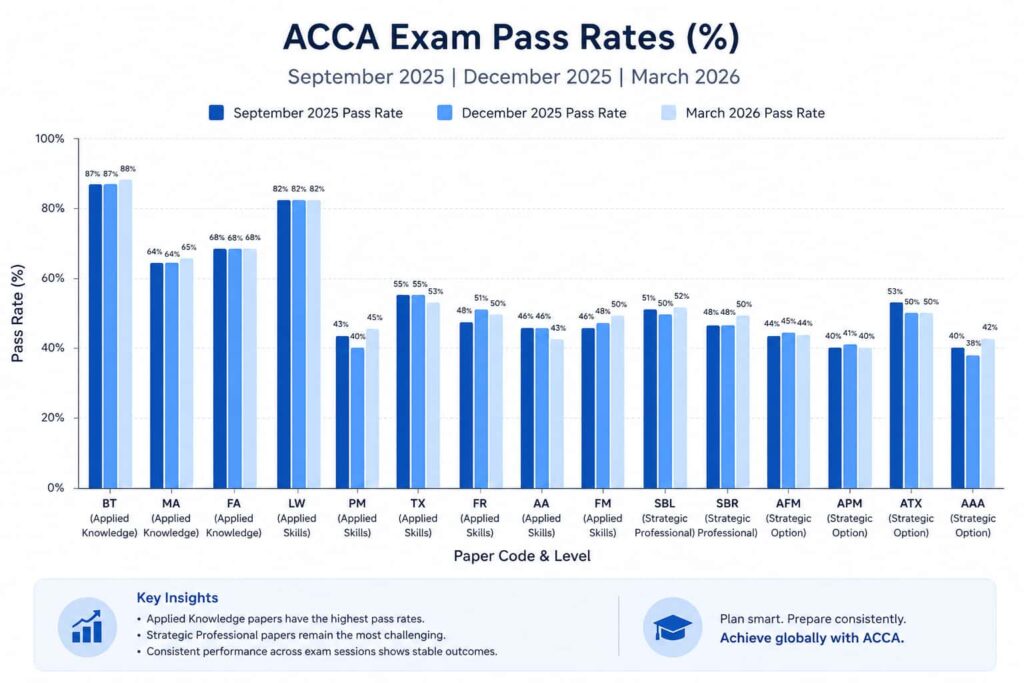
| Paper Code & Level | September 2025 Pass Rate | December 2025 Pass Rate | March 2026 Pass Rate | Historical Challenge Level & Core Exam Format |
| BT (Applied Knowledge) | N/A | 87% | N/A | Highly accessible; multiple-choice on-demand format. |
| MA (Applied Knowledge) | N/A | 64% | N/A | Introduces cost calculations; quantitative focus. |
| FA (Applied Knowledge) | N/A | 68% | N/A | Core accounting concepts; double-entry journal postings. |
| LW (Applied Skills) | N/A | 82% | N/A | Legal concepts; high pass rates with consistent study. |
| PM (Applied Skills) | 43% | 40% | 45% | Analytical hurdle; requires calculation and business analysis. |
| TX (Applied Skills) | 55% | 55% | 53% | Structured but detailed tax calculations. |
| FR (Applied Skills) | 48% | 51% | 50% | Tests consolidation methods; medium difficulty. |
| AA (Applied Skills) | 46% | 46% | 43% | Concept-heavy audit logic; requires clear written auditing steps. |
| FM (Applied Skills) | 46% | 48% | 50% | Capital management math; requires consistent practice. |
| SBL (Strategic Professional) | 51% | 50% | 52% | Executive scenario analysis; values business communication. |
| SBR (Strategic Professional) | 48% | 48% | 50% | Advanced reporting theory; requires applying IFRS standards. |
| AFM (Strategic Option) | 44% | 45% | 44% | Complex finance topics, including mergers and acquisitions. |
| APM (Strategic Option) | 40% | 41% | 40% | Qualitative performance modeling; requires strong business logic. |
| ATX (Strategic Option) | 53% | 50% | 50% | Comprehensive tax planning; highly detailed regulations. |
| AAA (Strategic Option) | 40% | 38% | 42% | Rigorous professional auditing case studies. |
The Practical Experience Requirement (PER) Bottleneck
Earning the qualification requires more than passing exams. Candidates must complete the Practical Experience Requirement (PER) to transition from an Affiliate to a full Member.
The PER framework consists of three core components:
36 Months of Relevant Experience: This work can be completed before, during, or after passing the exams. It can span multiple employers and include part-time roles or internships.
9 Performance Objectives: Candidates must complete all five mandatory Essentials and any four Technical objectives of their choice. This structure ensures candidates demonstrate actual workplace competence alongside their technical knowledge.
The Workplace Mentor: Every completed objective must be verified and signed off inside the MyExperience portal by an approved Workplace Mentor. This mentor must be a certified, qualified accountant recognized by a global professional accounting body, which can sometimes be a challenge for candidates working in smaller firms or start-ups.
2026 Fee Structure: Administrative and Academic Costs
The overall cost of the qualification includes fixed administrative fees paid directly to the ACCA body, alongside variable coaching and study material costs.
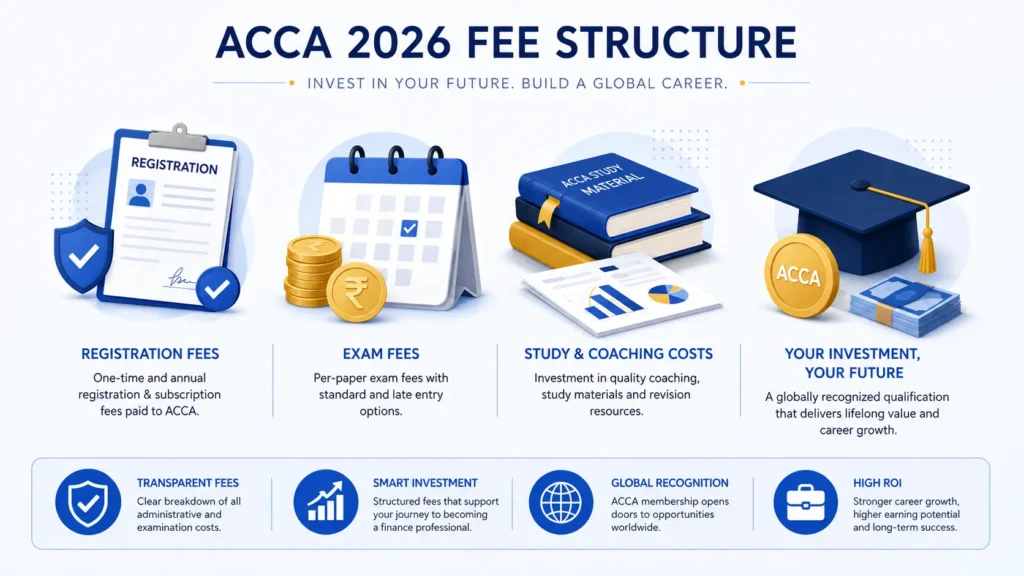
Administrative and Registration Fees
These fees are based on the official 2026 administrative rates, converted at a standard exchange rate of 1 GBP=110 INR (subject to currency market fluctuations).
| Administrative Fee Type | Cost in GBP | Estimated Cost in INR | Frequency / Strategic Notes |
| Initial Registration Fee | £89 | ~₹9,790 | One-time entry registration. |
| Annual Student Subscription | £140 | ~₹15,400 | Due by January 1st to maintain active student status. |
| EPSM Module Fee | £83 | ~₹9,130 | One-time fee paid before attempting Strategic papers. |
| Re-registration Fee | £89 | ~₹9,790 | Penalty charged if annual subscription lapses. |
Per-Paper Exam Fees: Standard vs. Late Entry Penalties
ACCA applies substantial financial penalties to registration entries made after the standard booking deadline. Booking during standard windows is critical to avoid unnecessary costs.
| Examination Tier | Standard Entry Fee | Late Entry Penalty Fee | Standard Fee in INR |
| Applied Knowledge (BT, MA, FA) | £98 to £123 | N/A (On-demand CBE) | ~₹10,780 to ₹13,530. |
| Applied Skills (LW to FM) | £160 to £173 | £409 to £439 | ~₹17,600 to ₹19,030. |
| SBL (Strategic Business Leader) | £282 to £295 | £467 to £475 | ~₹31,020 to ₹32,450. |
| SBR (Strategic Business Reporting) | £208 to £229 | £467 to £475 | ~₹22,880 to ₹25,190. |
| Options Papers (AFM, APM, ATX, AAA) | £208 to £229 | £467 to £475 | ~₹22,880 to ₹25,190. |
💡 The Failure Tax: Candidates can avoid the “Failure Tax”—the financial cost of re-sitting an exam, paying the exam fee again, and buying updated study materials—by investing in structured study programs and utilizing past papers to secure first-time passes.
Earning Potential, Career Progression, and ROI in India
The qualification offers a strong return on investment in the corporate sector, with starting salaries that compare favorably to non-certified commerce graduates.
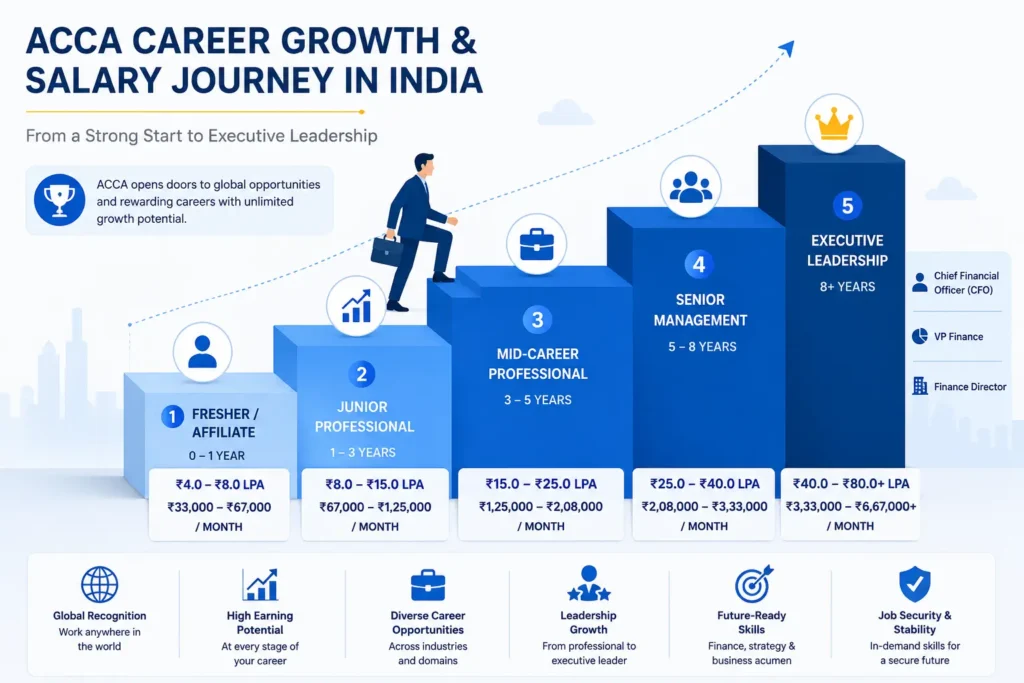
Experience-Wise Annual Compensation
The starting salary for freshers is competitive, and compensation scales significantly as professionals gain experience and take on managerial responsibilities.
| Experience Level | Annual Salary Range (LPA) | Average Monthly Gross | Common Corporate Job Roles |
| Fresher / Affiliate (0-1 yr) | ₹4.0 – ₹8.0 LPA | ₹33,000 – ₹67,000 | Audit Associate, Financial Analyst, Junior Accountant. |
| Junior Professional (1-3 yrs) | ₹8.0 – ₹15.0 LPA | ₹67,000 – ₹1,25,000 | Senior Analyst, Internal Auditor, Tax Consultant. |
| Mid-Career (3-5 yrs) | ₹15.0 – ₹25.0 LPA | ₹1,25,000 – ₹2,08,000 | FP&A Manager, Assistant Manager, Reporting Lead. |
| Senior Management (5-8 yrs) | ₹25.0 – ₹40.0 LPA | ₹2,08,000 – ₹3,33,000 | Finance Manager, Audit Manager, Controllership Lead. |
| Executive Leadership (8+ yrs) | ₹40.0 – ₹80.0 LPA+ | ₹3,33,000 – ₹6,67,000+ | Chief Financial Officer (CFO), VP Finance, Director. |
The Affiliate vs. Member Salary Gap
Completing the PER and transitioning from an Affiliate to a full Member has a direct impact on earning potential. Employers often pay a premium for full members who are certified to manage complex corporate reporting and advisory functions.
| Experience Level | ACCA Affiliate Salary Range | ACCA Member Salary Range | Net Salary Premium % |
| Fresher Level | ₹3.5 – ₹5.0 LPA | ₹5.0 – ₹7.0 LPA | 25% – 40% |
| 3 Years Experience | ₹7.0 – ₹10.0 LPA | ₹10.0 – ₹15.0 LPA | 20% – 30% |
| 5 Years Experience | ₹12.0 – ₹18.0 LPA | ₹18.0 – ₹28.0 LPA | 20% – 35% |
| 10 Years Experience | ₹18.0 – ₹28.0 LPA | ₹30.0 – ₹50.0 LPA | 25% – 45% |
City-Wise Salary Index and Cost of Living Dynamics
Corporate finance and consulting compensation varies by region, driven by local living costs and the concentration of multinational headquarters and GCCs.
| Metro Location | Salary Premium Index | Entry-Level Salary Range (LPA) | Mid-Career Salary Range (LPA) | Cost of Living Index |
| Bangalore | 112 | ₹5.5 – ₹11.0 | ₹13.0 – ₹20.0 | 105 |
| Mumbai | 108 | ₹5.0 – ₹8.0 | ₹14.0 – ₹22.0 | 115 |
| Delhi NCR | 106 | ₹4.5 – ₹8.0 | ₹13.0 – ₹20.0 | 102 |
| Hyderabad | 100 | ₹4.0 – ₹7.0 | ₹11.0 – ₹17.0 | 85 |
| Pune | 95 | ₹4.0 – ₹7.0 | ₹10.0 – ₹15.0 | 88 |
| Chennai | 92 | ₹4.0 – ₹6.5 | ₹10.0 – ₹16.0 | 82 |
Salary Profile by Employer Type
The corporate segment a candidate enters influences both their salary trajectory and their professional growth.
Global Capability Centers (GCCs): Centers operated by global financial entities (e.g., JP Morgan, Goldman Sachs, HSBC) offer some of the highest starting salaries, ranging from ₹10.0 to ₹18.0 LPA, with a focus on advanced analytics and cross-border consolidations.
The Big 4 Firms (KPMG, Deloitte, PwC, EY): Offer starting salaries of ₹6.0 to ₹10.0 LPA. While starting pay may be slightly lower than in GCCs, they provide rapid career progression, clear promotion paths every 2 to 3 years, and strong long-term market credibility.
Multinational Corporations (MNCs): Large global corporate operations recruit newly qualified accountants at ₹8.0 to ₹15.0 LPA, focusing on corporate governance, internal audits, and IFRS reporting.
High-Growth Fintechs & Start-ups: Fintech platforms offer starting packages of ₹10.0 to ₹20.0 LPA, often paired with stock options (ESOPs), requiring candidates to manage high-risk corporate capital and financial modeling structures.
Strategic Comparison Matrix: ACCA vs. ICAI CA vs. US CPA
Choosing the right qualification depends on a candidate’s long-term career goals and geographical target.
| Feature Comparison | UK ACCA (UK) | Indian CA (ICAI) | US CPA (USA) |
| Primary Focus Region | 180+ countries (UK, Middle East, SG) | India | USA & US multinational firms |
| Syllabus Core | IFRS & International Standards | Indian Accounting Standards, Tax & Corporate Laws | US GAAP & US Tax Law |
| Number of Exams | 13 papers | 3 levels (Foundation, Inter, Final) | 4 sections (FAR, REG, AUD, Discipline) |
| Passing Standard | 50% per paper | 40% per paper & 50% aggregate per group | Scaled score of 75 |
| Average Pass Rate | 40% – 50% | 10% – 15% (Final Level) | 45% – 55% |
| Exam Schedule Flex | Quarterly windows; paper-by-paper options | Two fixed windows per year | Continuous testing; 18-30 month window |
| Work Experience | 36 months; highly flexible | 2-3 years mandatory articleship | 1-2 years under a licensed CPA |
| Indian Practice Rights | None (No statutory audit signing) | Full statutory audit practice authority | None (No local audit practice) |
| Total Admin Cost | ~₹1,80,000 to ₹2,20,000 | ~₹20,000 to ₹30,000 | ~₹2.5 to ₹3.5 Lakhs (plus evaluation) |
| Total Cost (with Prep) | ~₹3.5 to ₹4.5 Lakhs | ~₹2.0 to ₹4.0 Lakhs | ~₹3.5 to ₹5.0 Lakhs |
| Starting Salary (India) | ₹4.0 – ₹8.0 LPA | ₹6.0 – ₹10.0 LPA | ₹6.0 – ₹8.0 LPA |
The Modern Finance Professional: Tech Stack and AI Integration
The role of corporate finance professionals has shifted from routine transaction logging and simple data matching to advanced data evaluation and business analysis.
With the rise of automated engines and artificial intelligence, traditional ledger entry and simple reconciliations are increasingly handled by software. As a result, the value of a modern finance professional lies in their ability to analyze automated outputs, translate complex data into business strategies, and build robust financial forecasts for senior leadership.
The ACCA curriculum has adapted to these changes by testing dynamic data interpretation and electronic spreadsheets directly within its Applied Skills and Strategic Professional exams.
Candidates can significantly increase their market value by pairing their technical financial training with key data tools:
Data Visualization (PowerBI / Tableau): Building interactive, real-time financial dashboards for management teams is a highly sought-after capability. Professionals who can use PowerBI to present business metrics command a 15% to 20% salary premium.
Financial Coding (Python / SQL): As corporate databases grow, the ability to write basic SQL queries to clean data or use Python for quantitative forecasting is a major differentiator. Candidates with these skills often command a 25% to 30% salary premium in global capability centers.
Advanced Spreadsheet Modeling (Excel): While visualization and coding tools are valuable additions, advanced Excel skills—including financial modeling, scenario analysis, and macro builds—remain the baseline requirement for corporate finance, investment, and advisory roles.
Step-by-Step Blueprint to Achieving Membership
Achieving full membership requires careful planning across exam registrations, the ethics module, and professional experience documentation.
Strategic Exam Planning and Timeline
The exam cycle runs four times a year, in March, June, September, and December. For the upcoming sessions, candidates should plan around key booking deadlines to avoid late registration fees.
September 2026 Sitting: Standard exam booking opens on May 5, 2026, and closes on July 27, 2026. The exams run from September 7 to September 11, 2026, with official results released on October 19, 2026.
December 2026 Sitting: Standard booking opens on August 4, 2026, and closes on October 27, 2026. The exams take place in the first week of December, with results expected in mid-January 2027.
Paper-Pairing Strategies to Manage Workload
Candidates should pair their papers carefully to maintain a balanced workload and avoid the risk of failing. It is best to avoid taking two heavy, calculation-intensive papers in a single quarterly sitting.
FR (Financial Reporting) and AA (Audit & Assurance): A highly strategic pairing. The reporting knowledge gained in FR directly supports the audit planning and risk evaluations tested in AA, making preparation more efficient.
FM (Financial Management) and PM (Performance Management): A pairing that requires caution. Both papers are highly quantitative and require extensive practice, meaning they should only be taken together by full-time students with ample study time.
SBR (Strategic Reporting) and AAA (Advanced Audit): A logical pairing for the final level. AAA requires a deep understanding of corporate reporting rules to evaluate audit scenarios, so taking it alongside SBR helps reinforce key concepts.
Selecting a Coaching Platform in India
Choosing the right study partner is a key step in managing the overall cost and ensuring exam success.
Online vs. Offline Coaching Cost Comparison
Candidates should factor in both tuition fees and potential living expenses when choosing between online and offline study formats.
| Coaching Cost Component | In-Person Classes (Major Metro Cities) | Live Online Programs (Standard Delivery) |
| Full Program Tuition Fees | ₹2,50,000 – ₹5,00,000 | ₹1,50,000 – ₹3,00,000 |
| Relocation and Accommodation | ₹1,20,000 – ₹2,40,000 / year | ₹0 |
| Daily Commuting Costs | ₹15,000 – ₹30,000 / year | ₹0 |
| Living Expense Adjustments | ₹50,000 – ₹1,00,000 / year | ₹0 |
| Study Materials & Revision Kits | ₹30,000 – ₹50,000 (often extra) | Included in package |
| Estimated Total Investment | ₹5,50,000 – ₹10,00,000+ | ₹2,00,000 – ₹4,00,000 |
Frequently Asked Questions
What are the main differences between the US CPA and the UK ACCA?
The US CPA is a US-licensed qualification focusing on US GAAP and US Tax Law, designed for public accounting and auditing roles within the US market.
The UK ACCA is a globally recognized qualification aligned with International Financial Reporting Standards (IFRS), offering broader geographical mobility across Europe, the Middle East, Asia, and Commonwealth countries.
Can a candidate complete the exams while working full-time?
Yes, the flexible exam structure is designed to accommodate working professionals.
With quarterly testing windows and the ability to register for exams individually, candidates can balance their preparation with their career demands.
How do candidates document and submit their PER?
Candidates record their employment details, work hours, and mentor information inside the MyExperience portal on the official myACCA website.
For each Performance Objective, the candidate must write a detailed 200-to-500-word statement explaining their tasks and reflections on learning, which is then sent digitally to their registered Workplace Mentor for verification and sign-off.
Is there an expiration period for exam passes?
There is no expiration limit for passes completed at the Applied Knowledge and Applied Skills levels.
However, at the Strategic Professional level, candidates must pass all remaining papers within a rolling seven-year window from the date of their first Strategic Professional pass; otherwise, those specific older passes will lapse and must be taken again.
Summary and Call to Action
The ACCA Course provides a practical, internationally aligned path for commerce graduates aiming to build a global finance career. While it does not grant statutory audit signing rights in India, its strong alignment with IFRS makes its graduates highly valued by multinational corporations, GCCs, corporate treasuries, and advisory firms worldwide.
By planning exam sittings carefully, completing the mandatory Ethics and Professional Skills Module (EPSM) early, and documenting relevant work experience under an approved mentor, candidates can progress efficiently to full membership. For those looking to stand out in the corporate finance market, pairing this qualification with data visualization and analytical tools (like PowerBI and Excel) provides a competitive advantage.
For those ready to take the next step, evaluating Gold-approved training partners and checking potential paper exemptions using the official ACCA exemption calculator are excellent starting points to launch an international corporate finance career.